

Cell Banking

A network of light blue hexagons with thin lines on white, visually representing a conceptual connection for RMC branding purposes.

A Long-Term Regenerative Option

Cell banking is an option for patients who want to take a longer-term approach to regenerative care. It allows cells derived from your own adipose tissue to be preserved for potential future use, reducing the need to repeat tissue harvest procedures down the road.

This option is not necessary for every patient and is discussed only when it aligns with clinical goals, personal preferences, and long-term planning considerations.

What Cell Banking Is

Cell banking involves the collection, preservation, and storage of cells derived from your own adipose tissue. The tissue is harvested once, processed, and then sent to a qualified, regulated cell storage facility where it is preserved under controlled conditions.

If additional treatments are needed in the future and are clinically appropriate, those stored cells may be retrieved and prepared for use without requiring another harvest procedure.

In practical terms, cell banking is about optional continuity. It gives patients the ability to plan ahead rather than repeating invasive steps each time treatment is considered.

How the Process Works
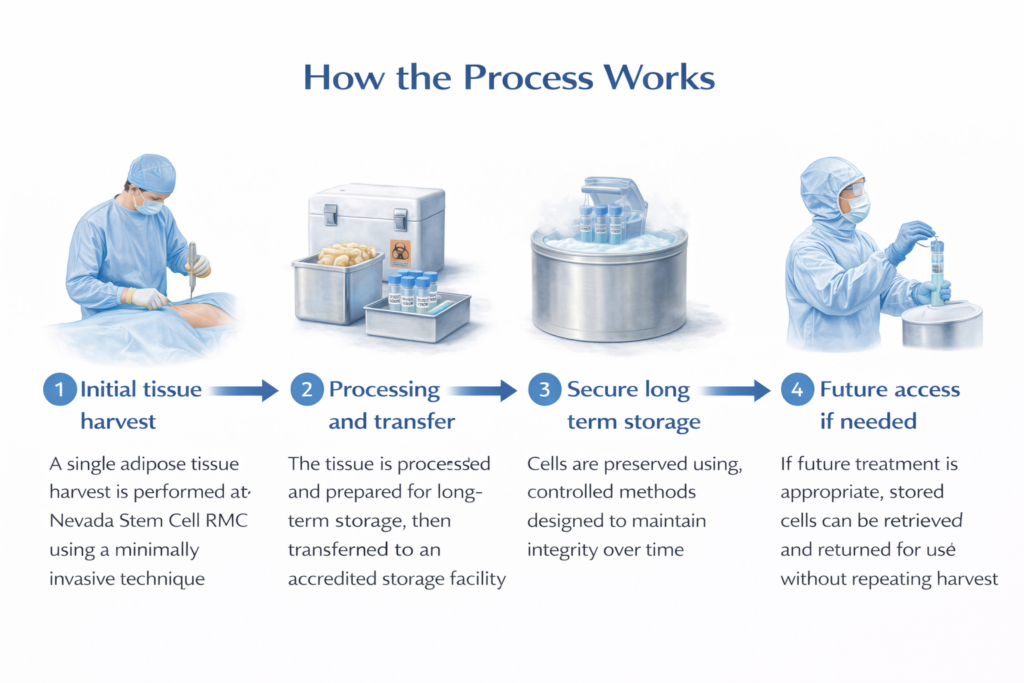
Cell banking : Four illustrated steps depict an RMC tissue process: collection, processing and storage, long-term holding, and potential retrieval.

This process separates the one-time procedural step from future treatment decisions.

Why Some Patients Choose Cell Banking

Cell banking may be appealing for patients who:
It is especially relevant for patients managing chronic or progressive joint conditions, or those who prefer to keep future options open even if no immediate follow-up treatment is planned.

Safety and Oversight

Cell banking involves multiple layers of oversight. Harvesting is performed by a physician. Processing and storage occur through specialized facilities that operate under established standards for handling, labeling, tracking, and storage.

Because the cells are derived from your own tissue, concerns related to donor compatibility are avoided. As with any medical process, risks and limitations exist, and cell banking does not guarantee future clinical benefit. It is a preparatory option, not a promise of outcome.

How Cell Banking Fits Into Treatment Planning

Cell banking is not a separate treatment and does not replace clinical decision-making. It is an adjunct option that may support future care if and when treatment is appropriate.

Some patients never use their banked cells. Others value knowing the option exists. The decision to bank cells is personal and should be made with a clear understanding of how it fits into your overall care plan.

Storage and Ongoing Costs

Cell banking involves an initial processing fee and an ongoing annual storage fee charged by the storage facility. These costs support secure handling, monitoring, and preservation over time.

We believe transparency is essential. Storage fees are discussed upfront so patients can decide whether long-term storage makes sense for their situation. For many, the cost is viewed as a tradeoff against repeating procedures in the future rather than as an added burden.

Our Approach

At Nevada Stem Cell RMC, cell banking is offered as an option, not a requirement. We focus on clear explanations, realistic expectations, and aligning choices with patient priorities.

Your consultation should clarify whether cell banking is appropriate for you, how it fits into your care plan, and whether the long-term benefits justify the commitment. Our role is to provide the information and guidance needed to make that decision confidently.
Physician-only care

Procedures performed by an MD/DO. No delegated injectors.

Precision matters

Fluoroscopy with IV contrast to confirm accurate positioning before injection.

Right tool for the right patient

We discuss options, pros/cons, and alternatives, not everyone is a candidate.

Explore Common Questions About Nevada Stem Cell RMC

Is this FDA-approved for arthritis?”
We’ll explain what’s known, what’s uncertain, and what that means for you during your consult.”
Most patients think in weeks-to-months, not days.
Hip, knee, shoulder, wrist; spine injections via pain physician.